

Let us be Country

February was Black History Month, so here are some slightly late words on blackness and the English countryside.
It was Saturday night, and we were out in the forest enjoying beers and burnt dogs around a campfire to celebrate my dear friend’s birthday. We giggled and sang and did all sorts of other Mumford and Sons activities late into the night, drunk on the rich pine air and woodsmoke.
I was maintaining the fire, placing logs on every now and then and blowing into the glittering embers, when someone turned to me and said “Edith, you’re quite the cowboy.” And I thought “yes I am.” It was one of the few moments in my life when I felt that someone saw a small section of my identity that rarely gets acknowledged, and that is my ‘countryness.’
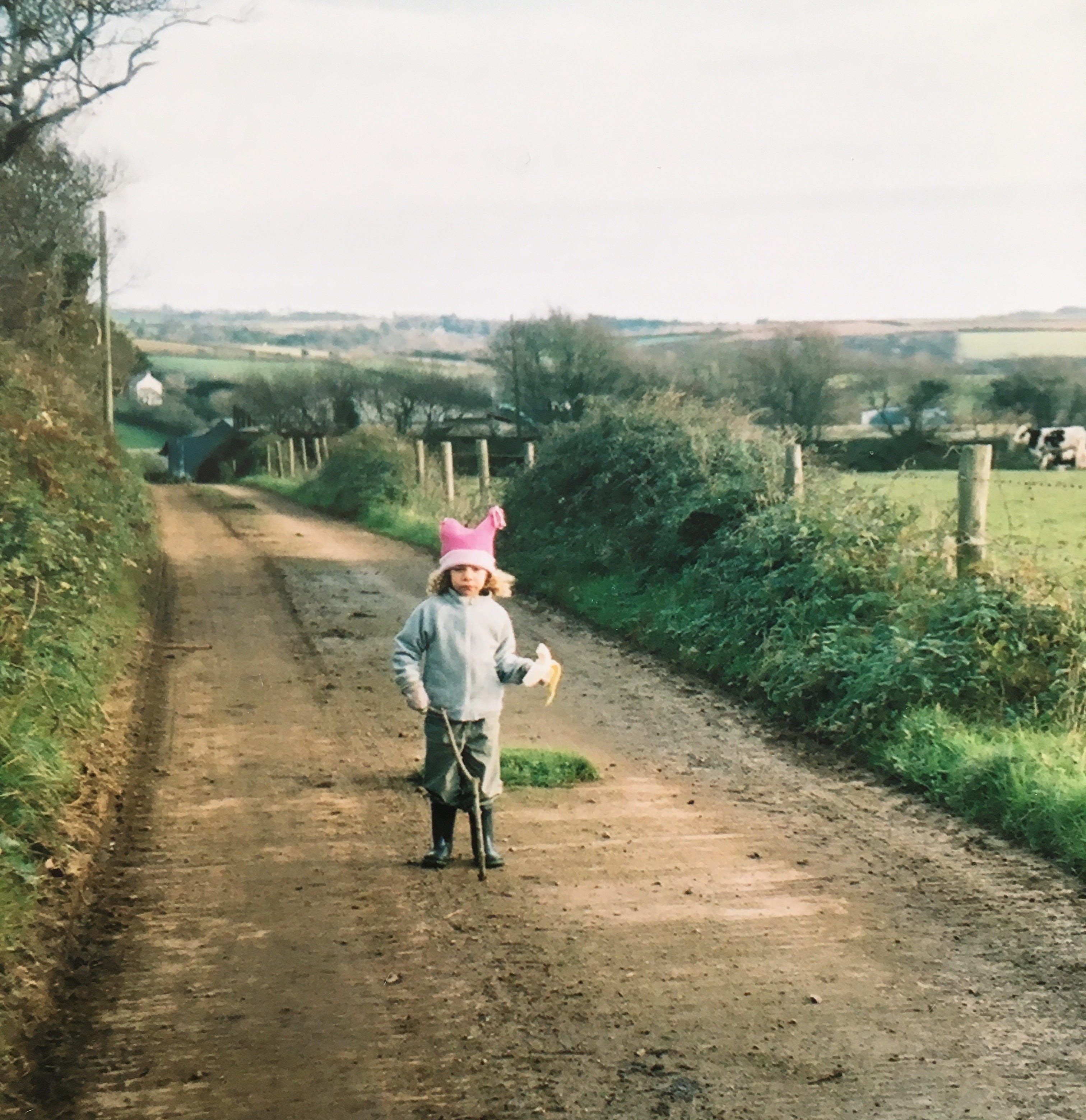
For context, I was born in London to a White British mother and a Black British father. However, from the age of three, I was raised in a tiny village nestled at the top of a creek in the depths of Southern Cornwall. The village, Constantine, is little more than a pub, a primary school, a church, a corner shop, and five miles of field. It’s the real deal; cottage-core, capital C Countryside. Whenever I return, I’m always half-expecting to run into Merry and Pippin smashing pints of Proper Job at the local. My childhood was often spent knee-deep in mud, or with small hands rummaging around rock pools, or rubbing sand from between my toes. I surfed and sailed and camped, frolicking through buttercupped fields or getting battered by sideways rain on the top of cliffs. I even lived on a dairy farm (fondly known as the smelly farm) for a year.
So being called a ‘cowboy’ unprovoked was strangely liberating, that was until the person rectified their statement by saying “But like, an urban cowboy, you know?”
The word “urban” has made my skin crawl ever since Tyler the Creator gave a speech at the 2019 Grammy Awards, where he said that ‘urban’ is essentially a glamorous way to say n*****.
Still, I feigned flattery, because maybe this was a comment on my cultural duality and not my ethnicity? But looking around the circle at my mostly white camping counterparts I thought ‘there’s no way that any of you would be referred to as an urban cowboy.’
It seems that blackness and urbanity are so intrinsically linked in people’s minds, particularly in the UK. This is starkly reflected in the country’s population distribution as only 2% of Black people in Britain live in the countryside. And for good reason – no amount of farmer’s markets or foraging workshops can cover up how hostile it can be out there. To live in the English countryside as an ethnic minority is to return to being at the whim of the majority. You must play their game, buy the wellies and the Musto sailing jacket, learn to play pool and fish and grow vegetables in your allotment and swim in the ocean all year round. You can even go as far as learning the fiddle and playing in the local folk band and still someone will always look you dead in the eye and tell you that you’re not from here.
The countryside offered a wonderful, peaceful way of life, but it never quite felt like mine. For that reason, I started to give it up. Bored of having to tell people “where I was really from”, London became my default answer. Slowly and carefully, I crafted an ‘urbanised’ film for myself, one that has thickened over the years to the point that I am just as surprised when I tell someone that I’m from a village of no more than 2,000 people.
There are so few points of cultural reference that show blackness in the UK as anything other than urban, that to reject this urban cultural expression felt like I was in some way cheating on my own ‘blackness’ in exchange for a caricature of ‘whiteness’.
However, a rural existence is not something that has been severed from Black people on a global scale; most countries in the Caribbean and Africa, and even in the Unites States, have an intrinsic rural identity, history and tradition. And yet, in the UK, Black farmers make up less than 1% of the agricultural workforce. The only Black farmer that I’m aware of in the UK has built a whole business empire (including a Brixton-based store, food brand and even a TV show aired on Channel 4 in 2006) around the trademark ‘The Black Farmer.’
The situation is chicken and egg. If we ever want Britain’s rolling green hills, babbling brooks, crags, moors, cliffs and woods to become comfortable and habitable for the ethnically diverse, we must forge and demand a rural culture of our own. Every drop of the sea-stained air and every petal of the gorse flower is mine and it is yours. Right now, I am turning to the work of Poppy Okotcha, a Black ecological food grower, horticulturalist and writer living in Devon. Just the fact that she embodies and promotes an unapologetically rural existence as a Black British woman gives me hope and inspiration.
Growing up I believed that there existed a ‘Black British Culture’ somewhere that I was excluded from because I lived in Cornwall. But now I have come to understand that this a myth as there is no such thing as ‘a’ Black British Culture. Black culture is not a singularity, it is rich and diverse and nuanced. It can be found in the mud, grass and sand as much as the rifts between concrete slabs. Blackness is Skepta’s Ignorance is Bliss, but also Nala Sinephro’s Space 1.8 and everything in between and everything to come as Black people see fit to define for themselves.
One day, I will return to the countryside, wellies at the ready and I will stand atop the Porthcurno cliffs and yell “This is my land!”
Until then, go touch some grass beloved ones.
Edith xxx
So good, Edith.